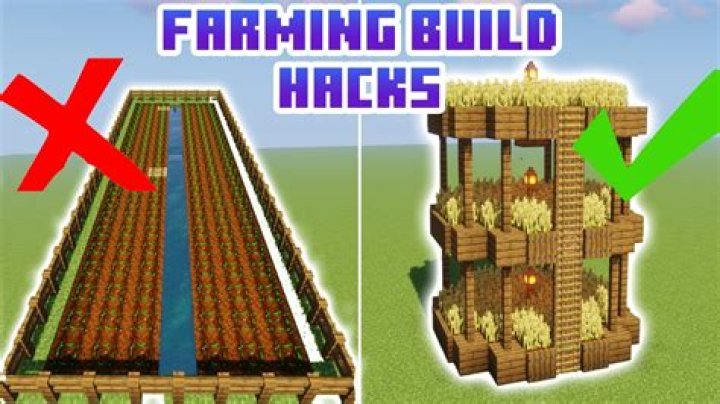
How do you grow crops in minecraft

Daniel Rodriguez
Updated on May 06, 2026
Bees can be used to accelerate the growth of crops by pollinating them. After collecting pollen from flowers, bees visually drop pollen particles as they make their way back to their hive or nest. If these particles land on a crop, the crop advances one growth stage. Each bee can pollinate up to 10 crops per trip.
There are other answers below:
To achieve ideal growing conditions, crops should be in a light level of 9 or higher, at least during day time. This is why growing crops underground without proper lightning is practically impossible. In order for crops to grow even faster, it’s recommended to place torches or other illuminating blocks nearby them. This means that they can continue growing during …
In this video I will be showing you the best and most efficient way to grow crops i… Time to grab a shovel and learn how to grow and plant crops in minecraft!
# BETTER TUTORIAL ON MY CHANNEL # :Dhttp:// this video I explain how to plant and grow crops. The materia…
1. To begin, locate fully grown wheat or beet crops for their seed. You can even break grass blocks to get wheat seeds. Now we are aiming for fully mature crops, so we can get the seeds alongside the main produce – wheat and beet. Breaking the crops before maturity will drop the seeds but not the food itself.
Step 1, To farm wheat, get wheat seeds. To get wheat seeds, you will need to destroy long grass. Long grass is easy to find if you are in a plains biome. When destroyed, long grass will drop wheat seeds.Step 2, Once you have enough seeds, make a hoe and a bucket. Hopefully you know the crafting recipes for these items. If not, just search for them on Google, …
Melon – The fruit crop harvested from fully-grown melons planted from melon seeds. Pumpkin – The fruit crop harvested from fully-grown pumpkins planted from pumpkin seeds. Farmland – The block where all the previous crops can and should be planted. It is created by using a hoe on dirt or grass. Bamboo – The crop harvested from a bamboo sapling.
Therefore, it’s important to make use of water in the plants that do. 3. Automate your work. As you get further into the game, automate your farms if possible. This saves a lot of time and increases your farms’ efficiency. 4. Use bonemeal to instantly grow crops. Certain crops grow instantly when you use bonemeal on them.
Is there some minimum distance that you have to maintain in order for my farm to continue growing? Yes. In order for crops to grow, a player must be within chunk update radius (in single player, your render distance – 2).
Most crops need light to grow. If you plant them outdoors, they will grow during the day, but if you add additional light they will grow at night too. Indoors or underground, crops will only grow if you provide artificial light for them.
Related Questions
How to make crops grow faster in Minecraft?
In order for crops to grow even faster, it’s recommended to place torches or other illuminating blocks nearby them. This means that they can continue growing during nighttime, even when sky level light is under 9. To check the light levels in a specific area, press F3 to open the debug screen. Growth Speed And Efficiency
How do you grow wheat in Minecraft?
Placing torches or other light sources near the crops allows them to continue growing at night or underground, and it prevents hostile mobs from spawning near them. Planting crops in alternate rows (that is, rows separated by bare farmland or a different crop) speeds up growth as well. In-game wheat at several stages.
What do you need for a crop farm in Minecraft?
Now, we’ll be moving on to the “How” of this Minecraft crop farms guide. What you’ll need: Wheat seeds, Hoe, Water, dirt/grass block, good lighting Wheat is one of the most commonly grown plants in the game.
How do you get crops to grow?
The most common tactic is to flood the field with water (which harvests all the plants it touches), but other methods are possible as discussed below. Probability of a crop plant being in each of the eight growth stages, as a function of time. The progression of crops over time is shown in the plot to the right.